
The cost of the war is being counted not in the corridors of power in Washington or Tehran, but in Firozabad's darkened furnace rooms, Howrah's idle casting sheds, and a barbershop in Kochi where the wait is suddenly, inexplicably, an hour long, notes Prem Panicker in his must read blog on the Iran War.

The Indian rupee depreciated by 32 paise to close at 92.83 against the US dollar, influenced by escalating global tensions, particularly the US-Iran conflict, and the deadline for the RBI's instructions to banks to curb overnight positions.


Demand has fallen significantly in the US, which accounts for around 30 per cent of crude oil consumption and meets 60 per cent of its demand through imports.

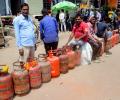
'Historically, India has depended on the Middle Eastern Gulf for nearly 90 per cent of its LPG imports. Shifting to alternative suppliers is not something that can happen quickly.'

Karex, the Malaysian company that makes roughly one in five of the world's condoms -- about five billion a year, supplying Durex and Trojan among others -- announced this week that it is raising prices by up to 30 percent. The reason is the Strait of Hormuz.

Iran has not closed the Strait. It remains open; however, due to current conditions and circumstances, ships are unable to pass through the Hormuz. Otherwise, Iran never wanted the Strait to be closed or blocked, the supreme leader's representative said.
As the oil moneybags get lighter, it will be increasingly difficult for Saudi Arabia and other Gulf states to continue to support incendiary radicals. And over time, there will be greater integration of Muslim life and culture into the "mainstream".
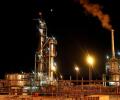
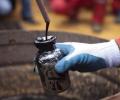
India, the world's third largest oil importing and consuming nation, is likely to save as much as Rs 1.8 lakh crore on import of crude oil and LNG if the trend of softening international energy rates continues, Icra said Wednesday. India, which meets over 85 per cent of its crude oil needs through imports, spent $242.4 billion on buying crude from overseas in the fiscal year ended March 31, 2025.
The Indian government has implemented several measures to mitigate external risks, support the balance of payments, and maintain macroeconomic stability amidst the ongoing West Asia crisis, according to Minister of State for Finance Pankaj Chaudhary.
Oil prices this year could surge up to $80 a barrel due to the increasing demand for the gasoline and disruptions in crude supplies from Nigeria, said a senior Iranian oil official.
The policy review observed that the moderation in inflation, excluding food and fuel, that was witnessed in the first quarter of 2017-18 has "by and large, reversed".

Indian benchmark indices Sensex and Nifty closed lower in a volatile session due to profit-taking in banking and financial shares, despite earlier gains driven by easing geopolitical tensions. Analysts suggest investors remain cautious and are not aggressively chasing the recent rally.

The rise in consumer price index (CPI) inflation could see the Reserve Bank of India (RBI) in an extended pause mode as regards interest rates, and in turn, keep the market rally in check, believe analysts. Signs of inflation cooling off in the US, however, is likely to provide some cushion as the expectations of a change in stance by the US Fed as regards interest rates is likely to aid sentiment. Back home, CPI inflation surged for the first time in five months to 4.81 per cent in June 2023, and was higher than the street's expectations of 4.58 per cent.

The ongoing oil price decline is mainly a result of oversupply in the global market

Finance Minister Nirmala Sitharaman's biggest challenge will be to find a new growth driver, particularly against the backdrop of a global economy ravaged by heightened uncertainty and fragmentation, financial markets on a precipice, and global commodity prices on a continued uptrend.

Iran has blamed the US for disruptions in oil and gas shipping through the Strait of Hormuz, citing 'destabilising actions' as the cause amid the ongoing West Asia conflict and rising energy prices.

The ministry of petroleum and natural gas on Friday reiterated that India has sufficient stock of crude oil, petrol and diesel, while ensuring an uninterrupted supply of LNG and LPG despite disruptions caused by the ongoing West Asia conflict.
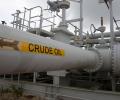
Production growth in India's eight core infrastructure sectors slowed to a three-month low of 2.3 per cent in February, impacted by contractions in crude oil, natural gas, and refinery products output.

If TVK MLAs and ministers are perceived as clean, or demonstrably cleaner than their predecessors, the credibility dividend will be enormous. The voter will feel rewarded, points out Ramesh Menon.

The central bank is yet to consider actions such as a rate hike or mobilising dollar inflows from non-resident Indians to boost forex reserves as it cannot afford to continue with them for long when the rupee's internationalisation tops its agenda, explains Tamal Bandyopadhyay.

'We are profoundly energy-dependent on the Gulf. That dependency must now be redirected towards the United States, because we require American permission to procure oil.' 'We additionally require Iranian permission to acquire oil from that source. So India now has to seek two separate permissions merely to secure its energy supply.' 'Should we be compelled to source from America, or from Venezuela -- which is, in effect, American-controlled supply -- that will inevitably carry a price premium, an elevated shipping cost, and a considerably extended delivery timeline, given the distances involved.'

'US and Iran have not annulled the ceasefire, and the possibility of continuing negotiations remains open.'

IndiGo operator InterGlobe Aviation had a mildly encouraging third quarter in financial year 2026 (Q3FY26).

Crude oil's long price slide might be ending, feel some experts. Last Friday, the price of Brent crude, seen as a benchmark for what India uses, saw a low of $75.3 a barrel - it is now trading around $79. The fall has been nearly a third from its high seen in June, only five months earlier.

Tensions escalate between Iran and the US following an attack on an Iranian commercial vessel in the Sea of Oman, with both sides trading accusations over maritime security and ceasefire violations.

'...especially pressure on the rupee, the current account deficit, and foreign exchange outflows.' 'The key question over the next several months is whether the government can prevent external turbulence from feeding into domestic economic pessimism.'

According to sources, the Indian Navy warships are on standby to provide assistance or help required by merchant vessels.
The Consumer Price Index-based inflation rose to 5.11% in January

As the rupee has been on a downward slide and crossed 90 a dollar, consumer electronics firms are looking to raise prices of products ranging from air conditioners (ACs) to television panels up to 10 per cent.
The drop in oil to around $50 a barrel this year has triggered steep cutbacks in production of US shale oil

The United States Central Command (CENTCOM) has announced that American forces are maintaining a strict maritime restrictive operation in the region, continuing to enforce a blockade against Iranian ports.
Volumes remain a concern because people still do not have confidence in the market.

Oil marketing companies (OMCs), paint manufacturers, tyre producers, and aviation stocks witnessed significant gains as Brent crude oil prices slipped below $70 per barrel. The price drop came after a double blow: The US imposed tariffs on Canada and Mexico, including energy imports, and OPEC+ - the group of major oil-producing nations including Russia - announced an output increase of 138,000 barrels per day, the first such hike since 2022.
The central bank is conducting a series of these meetings with individual banks as it prepares to announce the annual monetary and credit policy for the financial year 2011-12 on May 3.

Haryana Chief Minister Nayab Singh Saini has launched development projects worth 253 crore in Jind district, focusing on irrigation, infrastructure, health, and water supply.
The government will cut petrol and diesel prices when there is a sustained drop in global crude oil prices, Petroleum Minister Murli Deora said on Tuesday.
Projecting that global oil prices would stabilise at around $30-35 and help ease pressures on consumers, Reliance Industries Chairman Mukesh Ambani on Wednesday sought deregulation of natural gas, terming it as an alternate fuel in the medium term.
